 |
| Tussling theropods has been a classic depiction of paleoart ever since Charles R. Knight painted a beautiful canvas of two Dryptosaurus. Since then, Dilophosaurus has often been featured and I know I am not the first to illustrate something of this nature. Of course, the coloration is purely speculative but I thought that, with crests like they have, they must have made a fantastic display. |
Friday, July 17, 2015
Art: Dilophosaurus wetherilli

Art: Archaeopteryx lithographica
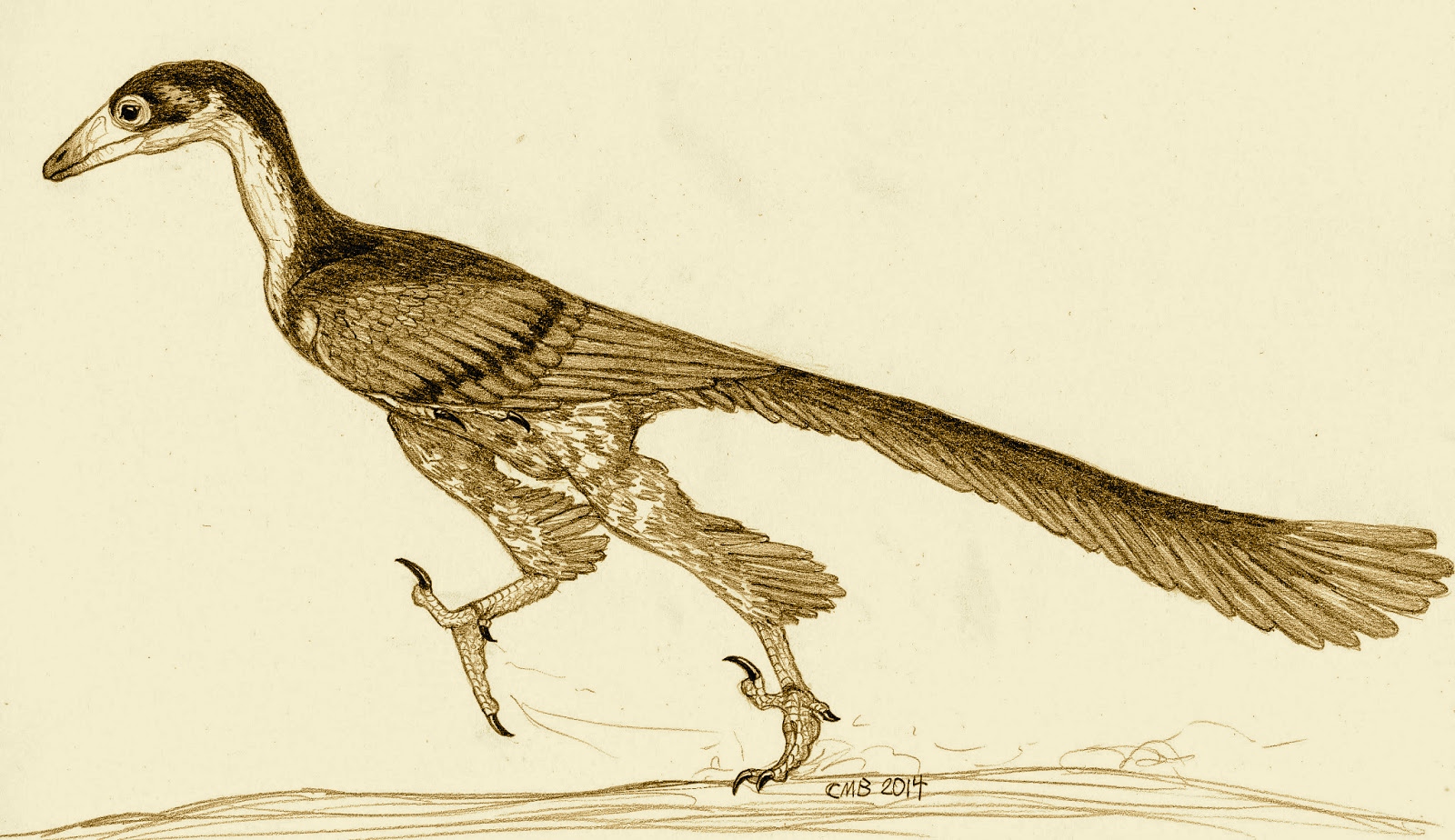 |
| I actually made three previous drawings of this bird but they were all unsatisfying in some respect. The first looked to dinosaurian, the second was posturing strangely. This one seemed to be the best. Although not particularly well preserved in Archaeopteryx, I felt the long leg feathers were appropriate since most other flying deinonychosaurs had them. In spite of its very birdlike appearance, I prefer to consider Archaeopteryx a dinosaur because its basic anatomy is nearly identical to that of the dromaeosaurids and other Deinonychosauria that are nearly always considered dinosaurs. Archaeopteryx might even belong to the same created kind as Velociraptor, implying that it too had feathers. |
Achillobator giganticus
Perle,
Norell, et Clark 1999
Evidence:
partial skull and fragmentary skeleton
Cenomanian
to Santonian
Bayanshiree
Svita
Dornogov’;
Mongolia
Biology:
5 meters long – 250 kilograms
Since it is known from only a single specimen, not much is
known of Achillobator biology. It is
believed that, given its comparably large size, it preyed on much larger
dinosaurs than other dromaeosaurids might (Paul 2010). However, the most common
herbivores of the Bayanshiree were ankylosaurs and therizinosaurs. Hadrosaurs
were rare, with only one known species, Bactrosaurus
mongoliensis. While it seems very likely that Achillobator might have preferred a hadrosaur to a potentially
dangerous therizinosaur or ankylosaur but, given the frequencies of the later
herbivores, it probably evolved its large size to cope with the more formidable
herbivores. It probably wasn’t fast enough to take down the ornithomimid Garudimimus brevipes also found in the
Bayanshiree. Achillobator may have
competed with Alectrosaurus but,
because of the dubious nature of that tyrannosaur, how they might have competed
would be speculation at best. Perhaps the tyrannosaur pursued primarily hadrosaurs,
limiting conflicts.
Evolution
There is very little controversy over the placement of Achillobator in the Dromaeosauridae and,
more specifically, in the Dromaeosaurinae. It appears to be closest to Utahraptor and Dromaeosaurus (Senter et al.
2012).
References:
Paul, G. S. 2010. The Princeton Field Guide to Dinosaurs.
Princeton, NJ: Princeton University Press.
Senter, P., J. I. Kirkland, D. D.
DeBlieux, S. Madsen, et N. Toth.
2012. “New Dromaeosaurids (Dinosauria: Theropoda) from the Lower Cretaceous of
Utah, and the Evolution of the Dromaeosaurid Tail.” PLoS ONE 7(5): e36790.
Wednesday, July 15, 2015
Wednesday, July 8, 2015
Dürrestein Formation
Carnian
Regione Veneto, Italy
Dinosaurs:
Prosauropoda indet.
Other Animals:
Margarosmilia sp.
Cryptocoelia zitteli
Amblysiphonella sp.
Atrochaetetes medius
Jablonskyia andrusovi
Uvanella irregularis
Plants:
Solenopora
sp.
Dendronella sp.
Notes:
This appears to be a marine deposit,
dominated by brain corals, sponges, and kelp (Tosti et al. 2014). However, Weishampel et al. (2007) reported possible prosauropod tracks for the
formation. Perhaps this lone dinosaur wandered over the drying reef as the
water receded into the giant wave that would contribute to the preservation of
the unwary ecosystem.
References:
Tosti, F., A. Mastandrea, A. Guido, F.
Demasi, F. Russo, et R. Riding. 2014.
“Biochemical and redox record of mid-late Triassic reef evolution in the
Italian Dolomites.” Paleogeography,
Paleoclimatology, Paleoecology 399: 52-66.
Weishampel, D. B., P. M. Barrett, R. A.
Coria, J. L. Loeuff, X. Xing, Z. Xijin, A. Sahni, E. M. P. Gomani, C. R. Noto.
2007. “Dinosaur Distribution.” In D. B. Weishampel, P. Dodson, and H. Osmólska.
The Dinosauria, Second Edition.
Berkeley, CA: University of California Press. 517-606.
Tuesday, July 7, 2015
Isalo II Formation (Makay Formation)
Anisian to Carnian
Faritany Toliara, Madagascar
Dinosaurs:
Theropoda indet.
Prosauropoda indet.
Sauropoda indet.
Other Animals:
Asteracanthus
sp.
Osteichthyes indet.
Colobodontidae indet.
Semionotidae indet.
Stegocephali indet.
Metoposauridae
Metoposaurus
hoffmani
Procolophonidae indet.
Reptilia indet.
Phytosauria indet.
Phytosauridae indet.
Rhynchosauria indet.
Unnamed rhynchosaur species
Isalorhynchus
genovefae (including Hyperodapedon genovefae)
Azendohsaurus
madagaskarensis
Archosauria indet.
Pseudosuchia indet.
Sphenodontia indet.
Synapsida indet.
Kannemeyeriiformes indet.
Chiniquodon
kalanoro
Unnamed traversodontid species
Unnamed traversodontid species
Dadadon
isaloi
Menadon
besairiei
Notes:
Usually considered an ancient streambed, the
Isalo Group likely represents a flooding event or series of events that
overtook the valley during early Triassic colonization of the region. Although
it contains what appears to be the tooth of a sauropod (Burmeister et al. 2006), Weishampel et al. (2007) listed only prosauropods
for the formation and may have been indicating that the tooth, and possibly
other teeth assigned to Theropoda, might be prosauropods, or that the confusing
archosauromorph genus Azendohsaurus is
a dinosaur. In all honesty, it is a little presumptive to assume these teeth
belong to anything specifically. All the misidentification has contributed to
confusion over the assigned epoch of the strata, but other genera certainly
nail down a Triassic or possibly very early Jurassic date. Freshwater
hybodontiform sharks were common along with giant salamander-like metoposaurs.
On the land, dinosaurs were rare and, as of yet, no specific families have been
identified. A few species of cynodonts, from herbivorous traversodonts to
hunting Chiniquodon, were relatively
common. It seems the bulky dicynodonts were even more rare than dinosaurs. The
crazy Azendohsaurus seems to have had
a little head, a long neck, and stump legs. As these weirdoes attest, bizarre
reptiles dominated fauna. Crocodile-like phytosaurs made watering holes
dangerous places and the pseudosuchians, crocs of the land, made terrestrial
life equally uncomfortable.
References:
Burmeister, K. C., J. J. Flynn, J. M.
Parrish, et A. R. Wyss. 2006.
“Paleogeographic and biostratigraphic implications of new early Mesozoic
vertebrates from Poamay, central Morondava Basin, Madagascar.” In J. D. Harris,
S. G. Lucas, J. A. Spielmann, M. G. Lockley, A. R. C. Milner, et J. I. Kirkland. The Terrestrial Triassic-Jurassic Transition. New Mexico Museum of Natural History and Science Bulletin 37:
457-475.
Weishampel, D. B., P. M. Barrett, R. A.
Coria, J. L. Loeuff, X. Xing, Z. Xijin, A. Sahni, E. M. P. Gomani, C. R. Noto.
2007. “Dinosaur Distribution.” In D. B. Weishampel, P. Dodson, and H. Osmólska.
The Dinosauria, Second Edition.
Berkeley, CA: University of California Press. 517-606.
Thursday, December 25, 2014
La Colonia Formation
Campanian to Maastrichtian
Provincia de Chabut, Argentina
Dinosaurs:
Theropoda indet.
Carnotaurus
sastrei
Titanosauria indet.
Ankylosauria indet.
Hadrosauroidea indet.
Other Animals:
Elasmosauridae
indet.
Sulcusuchus erraini
Meiolaniidae indet.
Patagoniaemys gasparinae
Chelidae indet.
Yaminuechelys
gasparinii
Serpentes indet.
Madtsoiidae indet.
Alamitophis
argentines
Boidae indet.
Enantiornithes indet.
Argentodites
coloniensis
Coloniatherium
cilinskii
Reigitherium
bunodontum
Plants:
Azolla
sp.
Crybelosporites
pannuceus
Cyathidites
australis
Dicksonia
sp.
Gleicheniidites
senonicus
Lugiomarsiglia
aquatica
Mirasolita
irupensis
Molaspora
lobata
Paleoazolla
patagonica
Regnellidium
thomas-taylorii
Classopollis
sp. 1
Classopollis
sp. 2
Cheirolepidiaceae indet.
Lygistepollenites
sp.
Microchacrydites
sp.
Podocarpidites spp.
Arecipites spp.
Dicotyledoneae indet.
Inaperturotetradites sp.
Intratriporopollenites
sp.
Araceae indet.
Arecaceae indet.
Nelumbo
puertae
Pandaniidites sp.
Peninsulapollis
sp.
Nelumbonaceae indet.
Sparganiaceaepollenites sp.
Typha
sp.
Typhaceae indet.
Botryococcus
sp.
Botryococcus
braunii
Pediastrum sp. 1
Pediastrum sp. 2
Pediastrum
boryanum
Mougeotia sp.
Spirogira sp. 1
Spirogira sp. 2
Zygnema
sp.
Fungi indet.
Notes:
Despite the 1980s discovery of the horned
theropod Carnotaurus in the
formation, nothing has been published on other dinosaur remains from the
formation. However, some fantastic research has detailed the plant life of the
formation, providing a fairly accurate picture of the environment. It was a
swamp, possibly near the mouth of a river, emptying into a larger body of water.
It is a good possibility that it was part of a seacoast at the time, before
flooding or a landslide of some kind apparently buried both terrestrial and
aquatic inhabitants. Besides dinosaurs on land, snakes, particularly boids and
their relatives, like Alamitophis,
were common. They preyed on a variety of small mammals, including
multituberculates and dryolestids. The most common were Coloniatherium, a
rat-like dryolestid. The water was full of turtles, including relatives of the
modern mata mata and the amazingly horny meiolaniid Patagoniaemys. Commonly plying through the deeper water were
elasmosaurs, classic, long-necked plesiosaurs. Sulcusuchus was also a large mobile plesiosaur, but of a
short-necked, long-snouted kind. The plant life of the La Colonia is a fascinating
subject. Cúneo et al. (2014) is a
great read and details the genera and kinds of plants that dominated, from open
water to shoreline into the forest. It seems that floating plants like Azolla and water lettuce were dense in
calm water while lotus and aquatic ferns grew in shallow water and cattails
lined the shore. Tree ferns and palms dominated the forest.
References:
Cúneo, N. R., M. A. Gandolfo, M. C. Zamaloa, et E. Hermsen. 2014. “Late Cretaceous
aquatic plant world in Patagonia, Argentina.” PLoS ONE 9(8): e104749
Subscribe to:
Posts (Atom)